Fec/Donors
An investigation. Cohort v0.1.

Where the money lands.

38 named Indian-American donors. Eight election cycles. $6,019,690 to 346 federal recipients. The seat predicts where it lands better than the party does.

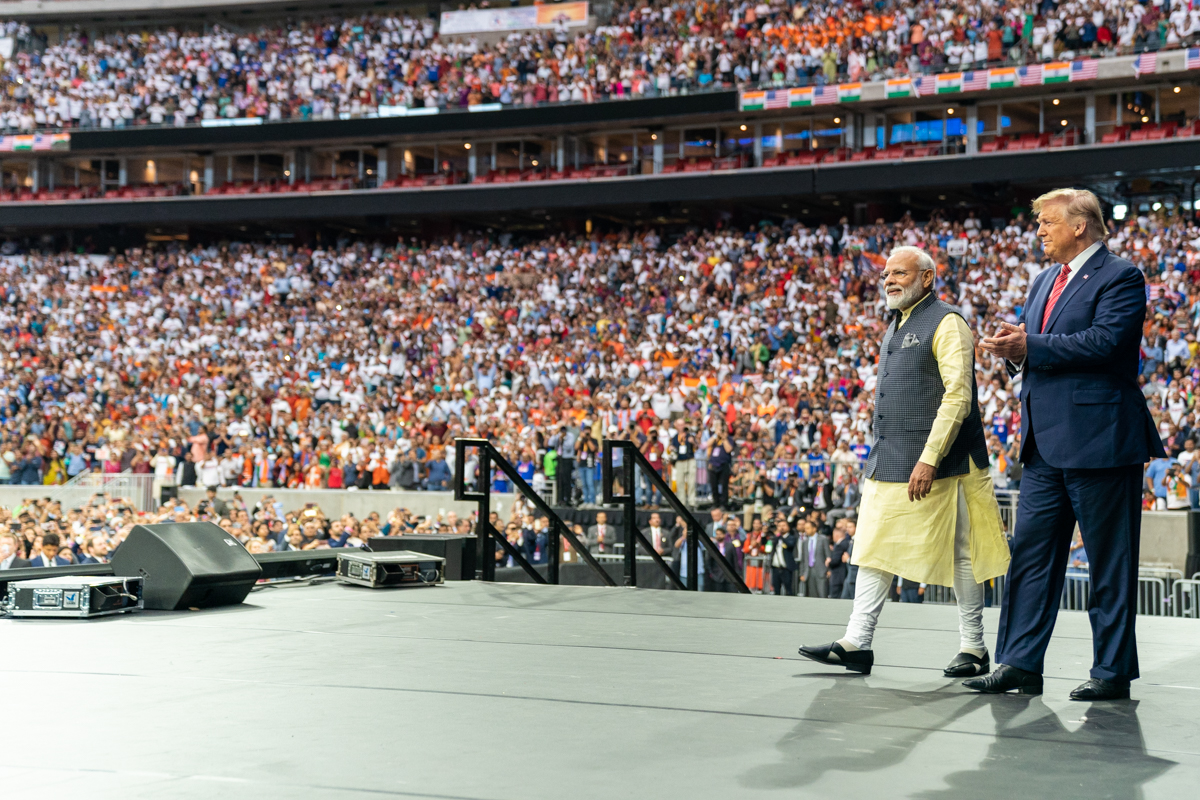
Prime Minister Modi addresses the Howdy Modi event at NRG Stadium, Houston, September 2019.
Howdy Modi, NRG Stadium, Houston, September 2019. State Department photo, public domain.
Cohort
38 named, 37 matched to FEC records, 1 with no qualifying FEC contributions found
Ledger
$6,019,690 across 2,626 itemised receipts to 346 recipients
Cycles
2012–2026 (8 cycles)
Last refresh
Thu, 04 Jun 2026 09:03:10 GMT

This site describes public political giving, not affiliation. Every figure traces to a public FEC Schedule A receipt. Donor locations are de-identified to city and three-digit ZIP. No claim is made about any individual's beliefs or organisational membership.

Follow the money

Start with the map. Homes on one end, seats and PACs on the other.

Each arc is one disclosed flow of dollars from a donor's home metro to a recipient. Filter by cycle and party; click an arc to open the underlying FEC filing.

Origin → destination
871 arcs · 245 committees · $2,351,742
Legend
Democratic
Republican
Other
donor metro
candidate / committee
arc width = log(dollars)
Cycle
PartyDensity
drag to pan · scroll to zoom · hover an arc to focus · click an arc for the FEC filing
Origin: donor home metro from FEC contributor address. Destination: congressional-district centroid for House recipients, state centroid for Senate and unspecified-district committees. Joint funds without a candidate (ActBlue, DCCC) are excluded. Arc width is log-scaled by dollars; only the top 150 arcs by amount are drawn at any time. Source: FEC + U.S. Census 2023 Gazetteer.
How to read this map
Origin

Where the dot starts is the donor's home metro, de-identified to city and three-digit ZIP, mapped to a coarse centroid. Never a street or a full ZIP.

Destination

Where the arc lands is the recipient's seat or committee: a congressional-district centroid for House recipients, a state centroid for Senate seats and committees without a district.

Arc width

Thicker arcs carry more dollars. Width is log-scaled by the reported amount, so a wide arc is many times the value of a thin one, not just a little more.

Colour

Colour marks the recipient's party where a candidate is named: blue for Democratic, red for Republican, grey for other or unattributed committees and conduits.

Where the money goes: about 40% of the $6,019,690 ledger reaches a candidate committee directly; the remaining 60% travels through PACs and conduits, such as ActBlue, before it reaches anyone. An arc is a disclosed contribution, not evidence of motive.

A scene

Across eight election cycles, the 38 donors on a public list filed 2,626 itemised Federal Election Commission receipts; 37 of the names matched to FEC records. Read together, those disclosed filings are the dataset behind the rest of this page. Every figure here comes from a public Schedule A receipt; none describes anyone’s beliefs or affiliations.

Why this scene

One donor, one date, one place, one recipient. Multiplied by 38 names and 8 election cycles, you get the $6,019,690 ledger behind the rest of this page.

Three questions

What this story asks.

01
Where does this money go?

Which candidates and committees these 38 donors funded across 8 cycles, and how much.

02
Is the seat doing the work, or the party?

Whether membership of one specific caucus predicts where the money lands better than the party label does.

03
Are these donors moving together?

Whether they give as one stable network or whether they reshuffle into different clusters cycle to cycle.

$6,019,690
given by 38 named donors
39%
of every direct dollar lands on an India Caucus member
2.6×
more concentrated than a comparable group of donors
346
recipients funded
Cycle by cycle

How the giving has moved over twelve years.

Eight election cycles, one bar each. Each bar is split between India Caucus members, other direct candidates, and money that travels through PACs or conduits before reaching anyone. Hover for the per-cycle figures.

2012
$210k
17% caucus
2014
$213k
27% caucus
2016
$429k
40% caucus
2018
$496k
37% caucus
2020
$1.3M
28% caucus
2022
$916k
37% caucus
2024
$1.8M
57% caucus
2026
$655k
53% caucus
India Caucus members
Other direct candidates (H, S, P)
Intermediaries (PAC, JFC, conduit)
All cycles total
$6,019,690
Direct candidate $
$2,417,643
To India Caucus
$948,364 (39%)
Hover any cycle
for the per-cycle figures
The story

The pattern is not the party. It is the caucus.

These 38 donors are not a party machine. Of the 37 matched to FEC records, 16 give directly only to Democratic candidates and 0 only to Republicans; 21 give to both. Across the cohort, dollars land on 182 Democratic and 75 Republican candidate committees.

What predicts where the money lands is less the party label than the seat. Of every direct dollar these donors send to a candidate committee, 39 percent lands on a member of the 13-strong India Caucus. Run the same calculation on every donor in the FEC corpus whose surname appears on a published South-Asian list, and the share drops to 15 percent. The cohort is 2.6 times more concentrated. The recipients include caucus leaders Krishnamoorthi, Khanna, and Subramanyam, and one Republican: Senator Jim Risch of Idaho, who chairs Senate Foreign Relations.

The list of names was compiled by others; we cite it, we do not endorse its framing. The shared recipients inside it are real and far tighter than chance would predict: a strong shared preference, not coordination. The groupings, though, do not stay still. From cycle to cycle the sub-clusters reshuffle. Same people, different teams. Shared preferences that move around, not a single organisation.

A second scene
28 September 2014 · Madison Square Garden, New York

Eighteen thousand seats sold out in days. Tickets were free, but donors covered the rest. Diaspora groups raised more than a million dollars in the lead-up. The Indian American Community Foundation hosted the reception. Vikram Pandit, Bharat Desai, Frank Islam and others were named in the press as part of the welcoming committee.

The audience that night included people who would, over the next decade, give millions more to candidates the data on this page tracks. Madison Square Garden 2014 was not a political action committee. It was a stage on which the same names recur in the FEC filings ever since.

The list

Top candidates these 38 donors funded.

Aggregated to the candidate level across all of their FEC committees, 8 cycles. Indian-American Democrats dominate. India Caucus leadership absorbs the largest share. One Hindu Republican challenger appears.

#CandidatePartyOfficeAffiliationCohort dollarsDonors
01Krishnamoorthi, S. Raja (all committees)DemocraticHouse
India CaucusS Asian heritage
$569,39137
02KULKARNI, SRI PRESTONDemocraticHouse
$119,06219
03GABBARD, TULSIDemocraticHouse
$117,91419
04KHANNA, ROHITDemocraticHouse
India Caucus
$109,86712
05SUBRAMANYAM, SUHASDemocraticHouse
India CaucusS Asian heritage
$84,15018
06THANEDAR, SHRIDemocraticHouse
India CaucusS Asian heritage
$71,05115
07OUR FREEDOM, OUR FUTUREDemocraticPresident
$70,30114
08BERA, AMERISHDemocraticHouse
India Caucus
$61,20513
09SHERMAN, BRADDemocraticHouse
India Caucus
$47,5007
10OBAMA, BARACK / JOSEPH R. BIDENDemocraticPresident
$42,3004
11KUMAR FOR CONGRESSDemocraticHouse
$40,3506
12TIPIRNENI, HIRAL VYASDemocraticHouse
$38,1017
13SHAH, AMISH DR.DemocraticHouse
S Asian heritage
$27,0349
14JONATHAN JACKSON FOR CONGRESSDemocraticHouse
$24,4006
15ROKITA, THEODORE EDWARDRepublicanSenate
$23,6002
See all 346 recipients including PACs and committees →
Ideology, side by side

Where the cohort lands on the donor-ideology axis.

Bonica's CFscore places every donor on a single left-to-right axis using their giving record. Negative is left, positive is right, zero is the centre of the donor universe. The cohort sits at median -0.64 against a heritage baseline median of -0.76 ; slightly to the right of South-Asian-named donors as a whole, but still firmly left of centre.

Ideology, side by siden_cohort=38 · n_heritage=179,073
centre-2-10+1+2leftright
Cohort (n=38) — median -0.64Heritage baseline (n=179,073) — median -0.76

Source: DIME v4.0 (Bonica). Cohort matched 38/38 by name+state. Heritage baseline = 179,073 contributors with South-Asian surnames, cohort excluded.

By party

More bipartisan in dollars than in donors.

Among the 37 matched donors, 16 give directly only to Democratic candidates and 0 only to Republicans; 21 give to both. The aggregate looks more even than the individuals because much of the Republican exposure is decided in the PAC layer rather than by direct giving.

Unattributed$3,334,014 · 55%
Democratic$2,389,505 · 40%
Republican$211,555 · 4%
OTHER$57,650 · 1%
Independent$19,800 · 0%
UNAFFILIATED$7,166 · 0%
Geography

Four metros. Distinct professional profiles.

Houston and Sugar Land. Chicago metro. The Bay Area. Northern Virginia. The four largest sub-clusters in the cohort, each with a distinct professional skew.

Read together with the recipient pattern, the picture is not a single ideological coalition. It is several professional networks, geographically concentrated, with a shared diaspora identity.

cohort total
$123k
$509k
$595k
$651k
$2.9M
Five quantile classes on non-zero values. Empty states shown in pale grey.
8 states with cohort activity · $6,019,690 total · Albers USA projection · hover or click a state
Explore the geography

The same flows, with the full set of toggles.

The lead map opened the story; this one lets you take it apart. Toggle between donors, arcs, origin states, and recipient states. The destination map is deliberately separate from the origin map because the two geographies answer different questions.

Lines are disclosed FEC contributions, not evidence of motive. Flow width reflects reported dollars; colour reflects recipient party. Click through to inspect a filing.

Origin → destination
871 arcs · 245 committees · $2,351,742
Cycle
PartyDensity
drag to pan · scroll to zoom · hover an arc to focus · click for the FEC filing
Arcs from donor home metro to recipient committee district, coloured by recipient party. Arc width log-scaled by dollars. Joint funds without a candidate are excluded. Source: FEC + U.S. Census 2023 Gazetteer.
Evidence trail

The supplementary pages are not appendices. Each one tests a part of the story.

The flow map shows direction. Sync events show dates when multiple donors moved together. Hotspots show which seats accumulate the money. Adjacent donors show behavioural overlap outside the cohort, with the same caution: overlap is not affiliation.

Sync events

Days when several donors gave to the same committee.

52 events
2 tagged
DateDonorsTotal
2025-12-07
3 donors
C00925461
$63,000
2023-06-29
5 donors
Modi US state visit (joint Congress address) (2023-06-22)
$42,084
2020-06-30
7 donors
C00401224
$23,270
2020-07-22
8 donors
C00401224
$17,800
2019-03-31
5 donors
C00401224
$17,650
Inspect all sync events →
Recipient hotspots

Seats where cohort dollars concentrate.

155 districts
Mann-Kendall trend
SeatTrendTotal
IL-H-08intensifying$521,545
TX-H-22persistent$121,062
HI-H-02persistent$117,914
CA-H-17persistent$114,417
VA-H-10sporadic$90,681
MI-H-13persistent$86,051
IL-Sintensifying$78,496
DE-Psporadic$70,301
Open the hotspot table →
Network reading

The graph is dense, but not a command structure.

Edges mean shared recipients. The useful signal is which donors bridge many recipient sets, which pairs are unusually similar, and which communities survive a higher threshold. Proximity on the canvas is algorithmic similarity, not proof of coordination.

density
90%

Share of possible donor-donor links present at the current export.

top bridge
PRIYA PANDIT

Highest weighted overlap across all donor neighbours.

communities
3

Donor-only groups in the projected graph.

Overlap bridges
  1. PRIYA PANDIT7.4236 linked donors · community 2 · $110,300
  2. ASEEM R MD SHUKLA7.2435 linked donors · community 2 · $67,200
  3. VIKRAM SHESHADRI7.1832 linked donors · community 1 · $23,797
  4. SHRADHA BHUTADA7.1534 linked donors · community 2 · $49,700
  5. BHARAT PALLOD6.9933 linked donors · community 2 · $6,679
Strongest pairs
  1. BHUTADA + PALLOD0.835 shared recipients
  2. BARAI + SHESHADRI0.753 shared recipients
  3. PRABHAKAR + SHESHADRI0.503 shared recipients
Bipartite layer
4 mixed communities

We also run Leiden on the donor-recipient graph itself, not only on the donor projection. That keeps candidates, PACs, and donors in the same structure before any public label is assigned.

SVD explains 72% of the first latent giving axis. Its distance agreement with the current UMAP layout is 0.14, so we treat the layout as a guide, not a claim.
Mixed communities
Community 0
13 donors · 133 recipients

Top recipients: ACTBLUE, KRISHNAMOORTHI, S, FIGHT FOR THE PEOPLE PAC

Community 1
20 donors · 103 recipients

Top recipients: KRISHNAMOORTHI, S. RAJA, HINDU AMERICAN POLITICAL ACTION COMMITTEE, GABBARD, TULSI

Community 2
3 donors · 94 recipients

Top recipients: KHANNA, ROHIT, WINRED, SHERMAN, BRAD

Community 3
1 donors · 16 recipients

Top recipients: JONATHAN JACKSON FOR CONGRESS, KHOT, NEIL, DAVIS FOR CONGRESS/FRIENDS OF DAVIS

Recipient hubs
RecipientDonorsTotal
KRISHNAMOORTHI, S. RAJAcommunity 137$480,945
ACTBLUEcommunity 036$1,442,571
KULKARNI, SRI PRESTONcommunity 119$121,262
GABBARD, TULSIcommunity 119$117,914
KRISHNAMOORTHI, Scommunity 019$66,995
SUBRAMANYAM, SUHAScommunity 118$85,150

Hubs are recipients that connect many cohort donors. They are not labels of influence or intent.

Three takeaways

What we found.

01
2.6× more concentrated on caucus members.

Of every direct dollar these donors send a candidate, 39 percent lands on a member of the India Caucus. Run the same calculation on every South-Asian-surname donor in the FEC corpus and the share drops to 15 percent.

02
A strong shared preference, not chance.

The recipients these donors share are far tighter than a comparable group of donors would share by chance. Across 1,000 matched draws, the cohort sits at the 100th percentile. It reflects common targets, sensitive to a few large shared recipients; it is not evidence of coordination.

03
Shared preferences that reshuffle, not one organisation.

Donor sub-clusters reshuffle cycle to cycle: same people, different groupings each time. The cross-cycle ARI reads unstable”. Shared preferences, not a chain of command.

Five findings

Each one paired with the data behind it. Sources cited inline.

  1. Cohort dollars converge on India Caucus members across both parties.

    Of $2,417,643 sent directly to candidate committees, $948,364 lands on the 13 confirmed members of the Congressional Caucus on India and Indian Americans. 9 percent goes to candidates of South Asian heritage. Caucus membership predicts giving more reliably than party affiliation.

    Recipients include caucus leaders Krishnamoorthi, Khanna, Subramanyam, Thanedar and Bera, plus Republican Senator Jim Risch on Senate Foreign Relations and Republican challenger Vin Kruttiventi in California's 14th. The Caucus is the largest single-country caucus in Congress, founded in 1993, with more than a hundred members across both parties.

    Sources: House India Caucus

  2. The cohort's recipient overlap reflects a strong shared preference.

    A 1,000-iteration matched-baseline permutation test, drawn from a pool of 15,637 South-Asian-surname donors matched to the cohort on state and giving amount, rarely produces an overlap as high as the cohort's. The cohort's observed mean pairwise Jaccard overlap of recipient sets is 0.146 against a baseline 95th percentile of 0.074.

    Read this as a strong shared preference, not coordination: the cohort lands on the same recipients far more often than a comparable group of donors would by chance. The result is sensitive to a few large shared recipients such as the ActBlue conduit, so it speaks to common targets, not a chain of command. We describe the giving. We cite, but do not assert, the source list's framing.

    Sources: Methodology

  3. Shared preferences that reshuffle cycle to cycle. Not a coordinated machine.

    Across 14 years and seven consecutive cycle-pair comparisons, the cohort's donor sub-clusters do not persist between cycles. The groupings reshuffle: same people, different teams. They share preferences. They do not appear to share an organisation.

    The Adjusted Rand Index measures partition similarity. Above 0.6 is "stable", 0.3 to 0.6 is "partial", below 0.3 is "unstable". The highest pair we measured is 0.14, so every pair sits inside the unstable band below 0.3. The data supports a reading of donors with parallel preferences toward the India Caucus and South-Asian-heritage candidates. It does not support an organisationally coordinated long-term coalition.

    Sources: Methodology

  4. Most cohort dollars route through PACs and conduits before reaching a candidate.

    About 40 percent of the $6,019,690 ledger reaches candidate committees directly; the remaining 60 percent passes through conduits such as ActBlue, the Hindu American Political Action Committee, the Indian American Impact Fund and the Indian American Victory Fund before it reaches anyone.

    Vehicles differ in kind: the Hindu American Political Action Committee and Americans4Hindus are Sangh-aligned PACs, while the Indian American Impact Fund, the Indian American Victory Fund and ActBlue are mainstream Democratic infrastructure. They should not be conflated. Some of these intermediaries publish bipartisan endorsement portfolios, which is part of why cohort dollars look more bipartisan in aggregate than the individual donors do. The PAC layer is where much of the party distribution is decided.

    Sources: Hindu American PAC endorsements · Indian American Impact Fund

  5. One politician absorbs nearly half a million dollars.

    Across his House campaign, his earlier House campaign, his Senate exploratory committee, and his leadership PAC, Representative Raja Krishnamoorthi absorbed $569,391 from 37 cohort donors over eight cycles. He lost the 2026 Illinois Democratic Senate primary to Lieutenant Governor Juliana Stratton on 17 March 2026.

    Krishnamoorthi is the House India Caucus co-chair and an Indian-American Democrat. He is not himself a Hindutva-aligned politician. He shows up at the top of the list because the cohort funds caucus members and Indian-American Democrats heavily, not because of an ideological match. The redistribution of his cohort capital after the primary loss is the live signal worth tracking through November 2026.

    Sources: Illinois Senate primary 2026

Three checks

What the numbers do, and don't, say.

Three tests on the same data. The first compares the headline percent against a comparable group of donors. The second asks whether the shared recipients could be chance. The third asks whether the donors move together as a stable group. The first two point to a strong shared preference; the third shows it reshuffles cycle to cycle rather than holding as one organisation.

Anchored comparison
The same calculation, run on a comparable group of donors.

We took every donor in the FEC corpus whose surname appears on the South-Asian-surname seed list (199469k+ contribution rows) and computed the same direct-dollar ratio. Comparing the two anchors what the headline percent actually means.

The 38 cohort donors39% ($937,864 of $2,417,643)
All matched South-Asian-surname donors15% ($4,426,259 of $29,713,691)
Cohort concentration
2.6×more concentrated on India Caucus members

The cohort routes a 2.6-times higher share of its direct candidate dollars to caucus members than the matched population does. 13 caucus candidates are in the roster. Same denominator construction on both sides.

Matched-baseline test
The cohort shares recipients far more tightly than the matched baseline.

Distribution of 1000 random South Asian-surname donor draws matched to the cohort's size and geography. The red rule is the observed cohort statistic.

p < 0.05
mean 0.051baseline 95th 0.074cohort observed 0.1460.000.040.080.120.16MEAN PAIRWISE JACCARD SIMILARITY OF RECIPIENT SETS
Cohort observed
0.146
Baseline mean
0.051
Baseline 95th pct
0.074
Pool / iterations
15637 / 1000

Read it like this: the grey bars show what matched random donor groups look like by chance. The red rule shows the cohort. It sits at the 100th percentile, beyond the 95th-percentile threshold. Similar donor shape, different recipient overlap.

Cross-cycle community stability (ARI)

unstable

Adjusted Rand Index between consecutive cycles' community partitions. ARI = 1 means identical clustering across cycles; 0 means independent of prior cycle. Thresholds: > 0.6 stable, 0.3 – 0.6 partial, < 0.3 unstable.

median ARI
0.09
cycles analysed
8
pairs computed
7
latest ARI
0.09
per-cycle pair
  • 2012201416 shared donors0.09
  • 2014201619 shared donors0.12
  • 2016201822 shared donors0.07
  • 2018202027 shared donors0.09
  • 2020202232 shared donors0.13
  • 2022202432 shared donors0.14
  • 2024202629 shared donors0.09
New source material

The larger workbook widens the investigation, but it does not lower the publication bar.

The partner ask requires a durable research pipeline, not a one-off graphic. The enriched workbook has been parsed into review files and a public-safe snapshot. It can guide the next reporting cycle: donor adjudication, PAC reconciliation, bios, and quarterly refresh.

Supplementary evidence

Useful leads, not headline evidence yet.

The partner workbook helps identify possible missing recipients, alias patterns, and donor records that need human review. It is not blended into the public story until each identity question and fundraising-route question is settled.

checked Tue, 26 May 2026 18:27:03 GMT
112,892
records reviewed
$35,338,596
raw amount to reconcile
6,471
possible donor identities
52%
routed through memo or earmark fields
Largest leads to adjudicate
ASHA JADEJA$5,529,101
MOTWANI JADEJA$2,972,000
SHACHI RATTAN$1,040,800
RAJEEV SINGH$1,016,980
VINOD GUPTA$869,356
ASHA JADEJA$663,877

These are not final public identities. The same person can appear under several name and location variants, so the rows stay in review.

What must be true before publication
Identity resolutionpartial

Workbook rows are normalised and lineage-preserved; aliases still need adjudication.

Address privacypass

The public JSON suppresses street addresses and exact ZIP5 values.

Conduit and memo handlingneeds review

Memo and earmarked rows are counted and flagged; final totals need conduit reconciliation before publication claims.

Affiliation and causation wordingpass with limits

Site copy must continue to describe reported contributions only.

33 high-priority rows have confirmed address matches.

799 high-priority rows still carry ambiguity flags.

91% need adjudication before use in named claims.

The intermediaries

Five committees route the cohort's money.

About 60 percent of cohort dollars flow through intermediaries before reaching a candidate. These vehicles are not all alike. The Hindu American Political Action Committee and Americans4Hindus are Sangh-aligned PACs; the Indian American Impact Fund and the Indian American Victory Fund are mainstream Democratic infrastructure; ActBlue is a partisan small-dollar conduit. We keep them distinct.

HAPAC

Hindu American Political Action Committee (HAPAC)

Non-qualified non-party PAC·Founded around 2014·C00536615

A bipartisan PAC explicitly organising around Hindu American political interests. Endorses candidates of both major parties.

HAPAC describes itself as the first Hindu American PAC in the United States. Its 2026 endorsement list includes Democrats Raja Krishnamoorthi and Suhas Subramanyam alongside Republicans Rich McCormick and Vin Kruttiventi. The PAC's stated mission is supporting candidates aligned with US-India relations, Hindu American civil rights, and skilled immigration policy.

Cohort dollars 2024 to 2026
$22,754
From
5 cohort donors
IA Victory Fund

Indian American Victory Fund

Joint fundraising committee·Founded 2024·C00925461

Joint fundraising committee aggregating contributions for an Indian American slate of federal candidates.

Joint fundraising committees pool contributions across multiple candidate committees and divide the proceeds per a published allocation. The Indian American Victory Fund concentrates cohort dollars and routes them across an Indian American candidate slate. Allocation details are on file with the FEC.

Cohort dollars 2024 to 2026
$84,000
From
3 cohort donors
IA Impact Fund

The Impact Fund

Multi-state federal PAC·Founded around 2017·C00876391

The political arm of the Indian American Impact organisation. Endorses and funds South Asian candidates across federal, state and local offices.

Indian American Impact Fund publishes endorsement criteria emphasising South Asian representation in elected office at all levels of US government. Its 2026 federal endorsements include Bushra Amiwala in Illinois 9, Amish Shah in Arizona 1, and others. Many of its endorsements are state and local rather than federal.

Cohort dollars 2024 to 2026
$25,000
From
1 cohort donors
Americans4Hindus

Americans4Hindus PAC

Super PAC·Founded around 2021·C00807776

Super PAC spending on independent expenditures in support of Hindu American political priorities.

Operates under the Super PAC structure permitted by Citizens United v. FEC, which allows unlimited contributions but prohibits coordination with candidate campaigns. Its independent expenditure filings are on Schedule E. Schedule E ingestion is in flight; once loaded, downstream candidate distribution will be mapped here.

Cohort dollars 2024 to 2026
$10,400
From
3 cohort donors
ActBlue

ActBlue

Conduit·Founded 2004·C00401224

The dominant Democratic small-dollar conduit. Most cohort dollars to Democratic candidates pass through here.

ActBlue is a registered conduit. Donors specify a recipient candidate committee; ActBlue passes the contribution through and reports it on the recipient's Schedule A. ActBlue is not the destination. Cohort giving via ActBlue should be read as earmarked dollars to named candidates.

Cohort dollars 2024 to 2026
$727,500
From
17 cohort donors
Sources: ActBlue
Background

What the published record says. And what we do not say.

The cohort label is not ours. The list of names came from a published source whose precise provenance we are still confirming; civil-rights and watchdog groups are the likeliest origin, but we do not over-attribute it. Whatever its source, we cite the list and do not assert that any individual is affiliated with any organisation.

Hindutva is a political ideology, distinct from Hinduism as a religion. Its formalisation traces to V. D. Savarkar's Essentials of Hindutva, published in 1923. Scholars including Christophe Jaffrelot place it in a lineage of ethnic nationalism. The Indian Bharatiya Janata Party emerged from this tradition.

Investigative outlets including The Caravan and Al Jazeera have documented a US Sangh Parivar ecosystem. Hindus for Human Rights and the Hindu American Foundation stake out competing positions on what that ecosystem is and does. The data on this site sits alongside this debate. It does not resolve it.

Campaign-finance data has its own boundary. FEC records show legal, disclosed federal contributions. They do not show sub-threshold giving, state races, dark-money vehicles, or private intent. Indian-origin donors who are US citizens or permanent residents are not foreign money under US campaign law; this story is about a disclosed donor network and its overlap with a public debate.

Last refresh: Thu, 04 Jun 2026 09:03:10 GMTCycles 2012–2026. 2,626 contributions.methodology